Essaouira, City of Wind
An eighteenth-century fortified port on the Atlantic, laid out on a grid by a French engineer, and blown through by the trade winds all summer.
A planned town on an old harbour
Essaouira — long known to Europeans as Mogador — was rebuilt as a fortified port in the 1760s under Sultan Mohammed ben Abdallah, who wanted a trading harbour open to Europe. The layout was drawn up by a French engineer, Théodore Cornut, and it shows: unlike the organic tangle of most Moroccan medinas, Essaouira has straight streets and right angles.
Essaouira's medina was inscribed as a UNESCO World Heritage site in 2001, cited in part as an unusually intact example of a late-eighteenth-century fortified European-influenced town in North Africa. Walking it feels different from Marrakech for exactly that reason. You can navigate it.
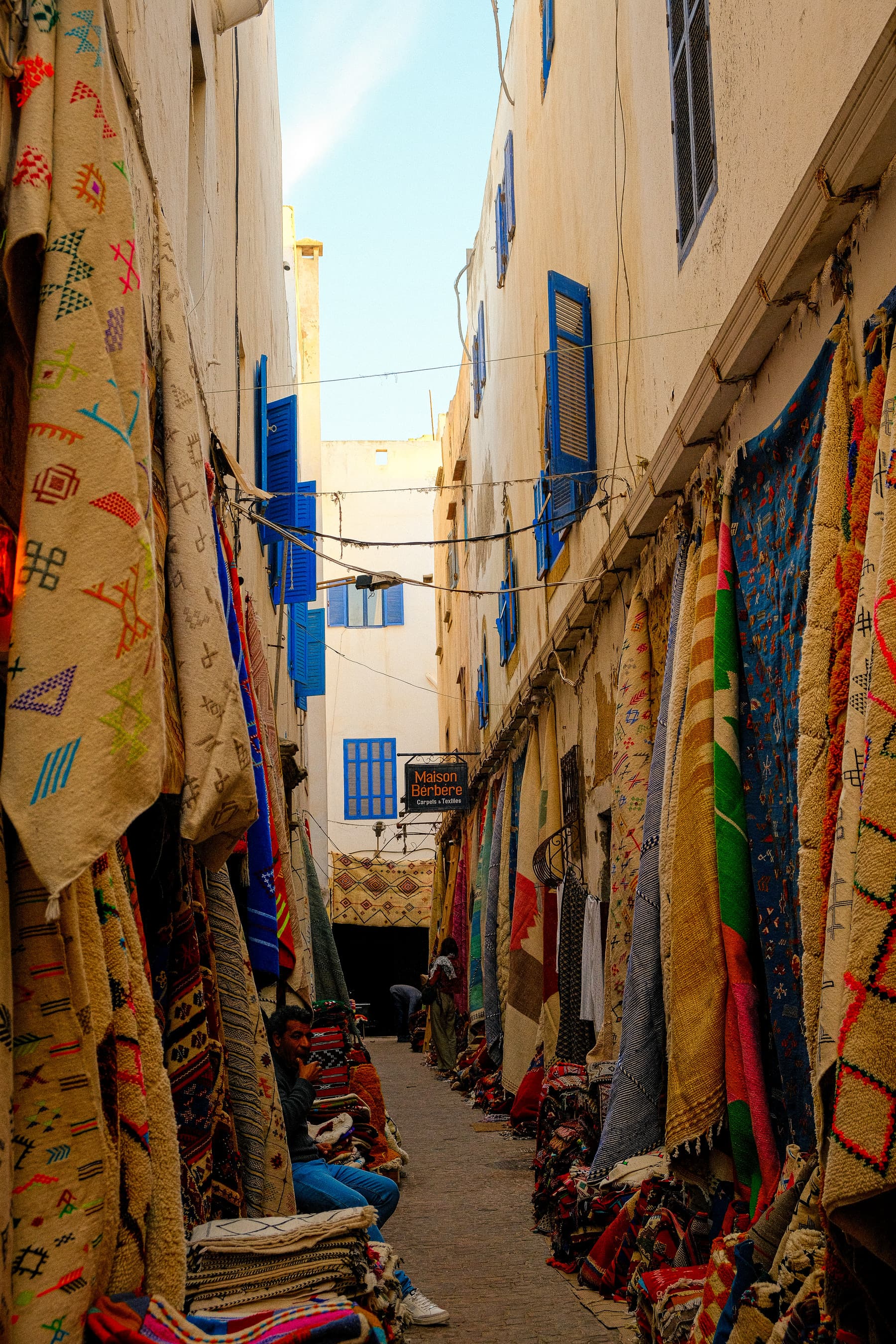
The lanes are still narrow, and the shops use every vertical surface. In one alley the rugs hang from the ground to the rooftops, between whitewashed walls and blue shutters, so the street becomes a corridor of colour with a strip of sky at the top.
The ramparts
The Skala de la Ville is the sea-facing rampart, a long stone platform with a row of old brass cannons pointed out at the Atlantic. It is the most photographed thing in the town and it earns it: the wall, the guns, the swell behind, and a great deal of weather.
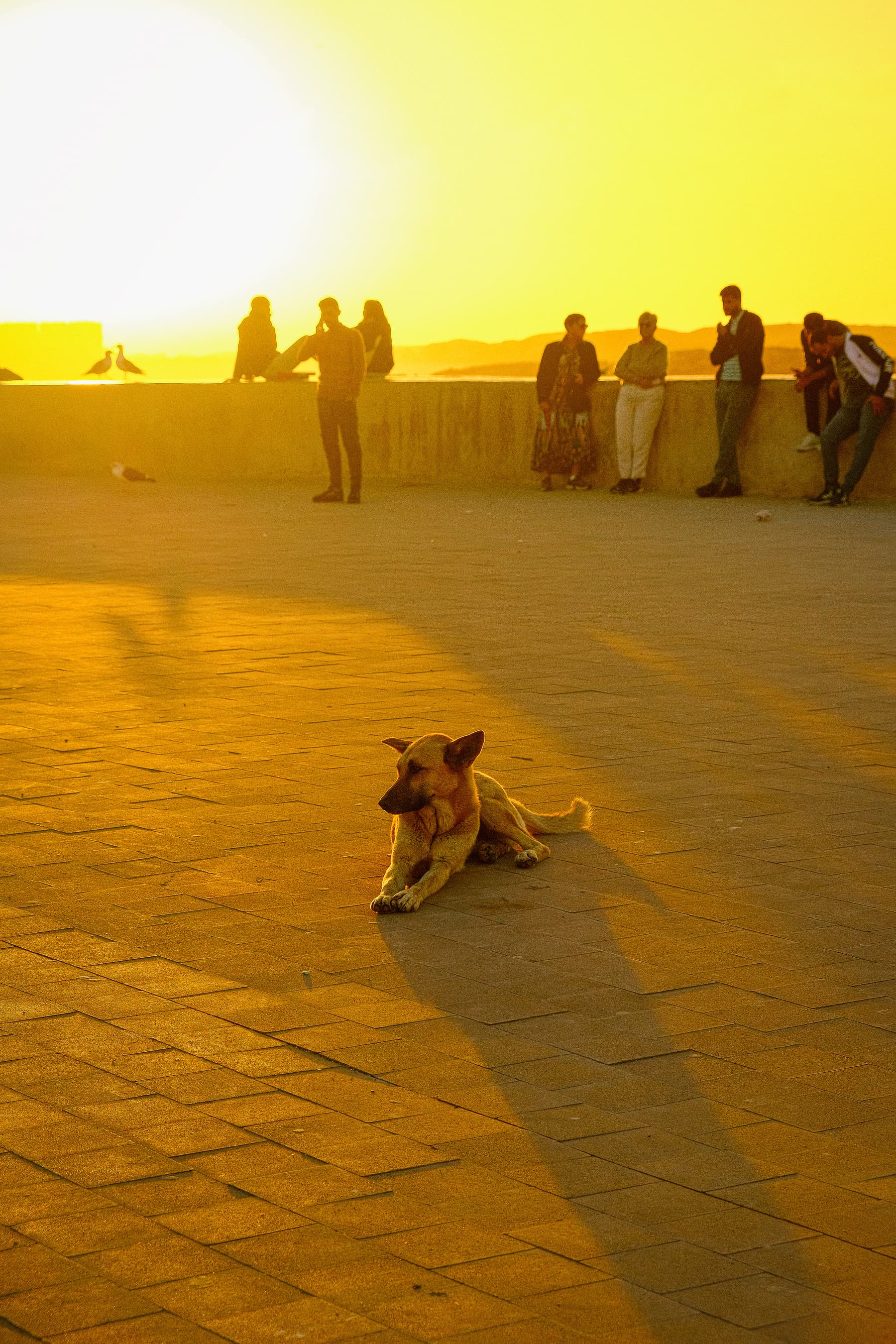
For most of the day the light off the Atlantic is bright and flat, and the stone is pale. It changes near sunset. One frame from the rampart was made then: the sun low over the sea, people leaning on the parapet, and a dog asleep on the warm stone with its shadow stretched out behind it.
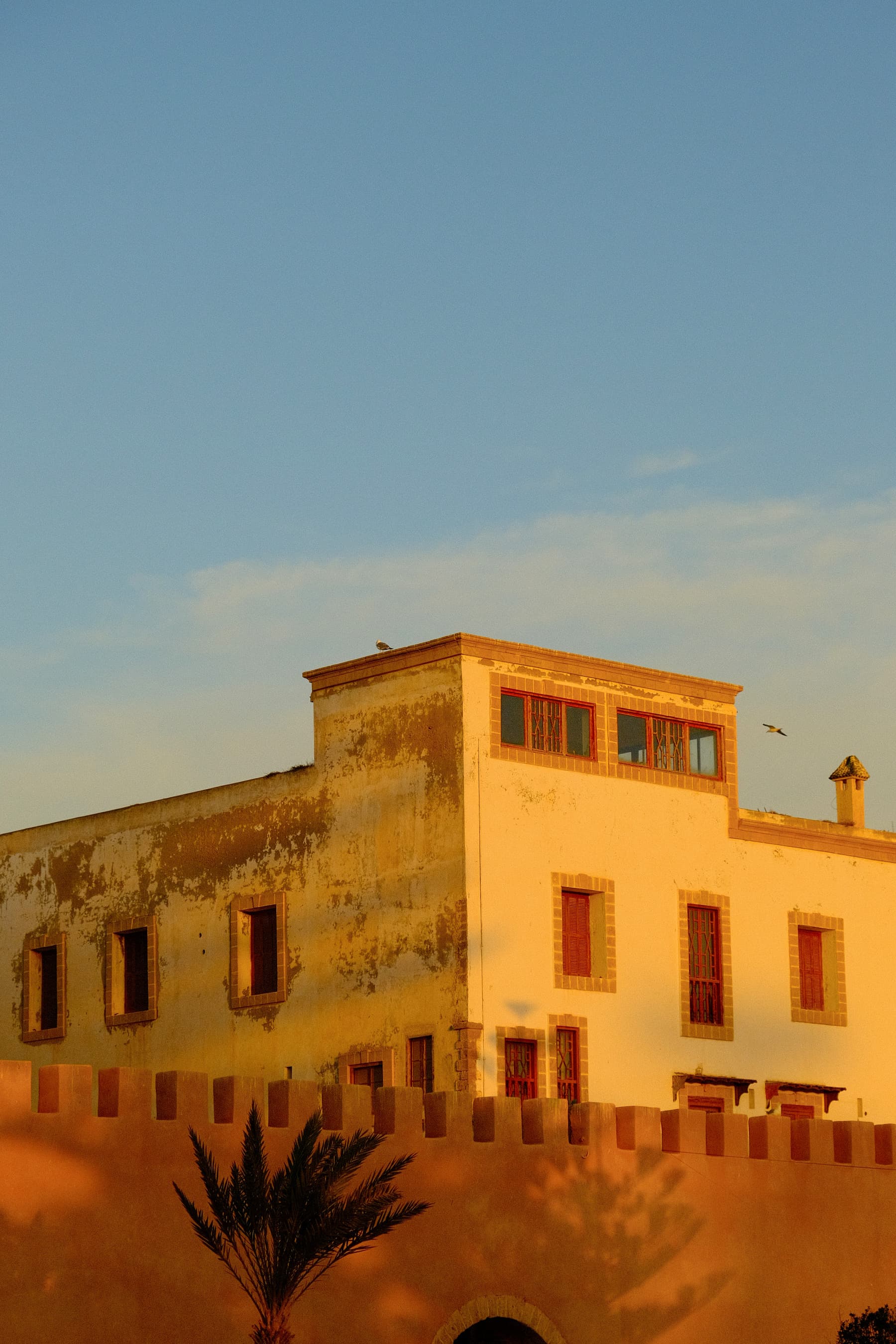
The other looks up from the foot of the town's crenellated walls at a house above them, in the last orange light, with the shadows of palms thrown across the stone. It is about mass and surface rather than a view, and it is the picture of Essaouira we come back to.
Why everything is leaning
The trade winds at Essaouira are relentless enough that the town is nicknamed the Wind City of Africa, and they are the reason it became a windsurfing destination. In summer they blow steadily most afternoons.
For a photographer this is mostly an inconvenience — sand in everything, a tripod that will not hold still — but it is also the character of the place, and pictures that hide it feel dishonest. The wind is in these frames whether or not you can name it: in the water, in the light, in the way the buildings have weathered on one side more than the other.
The road out
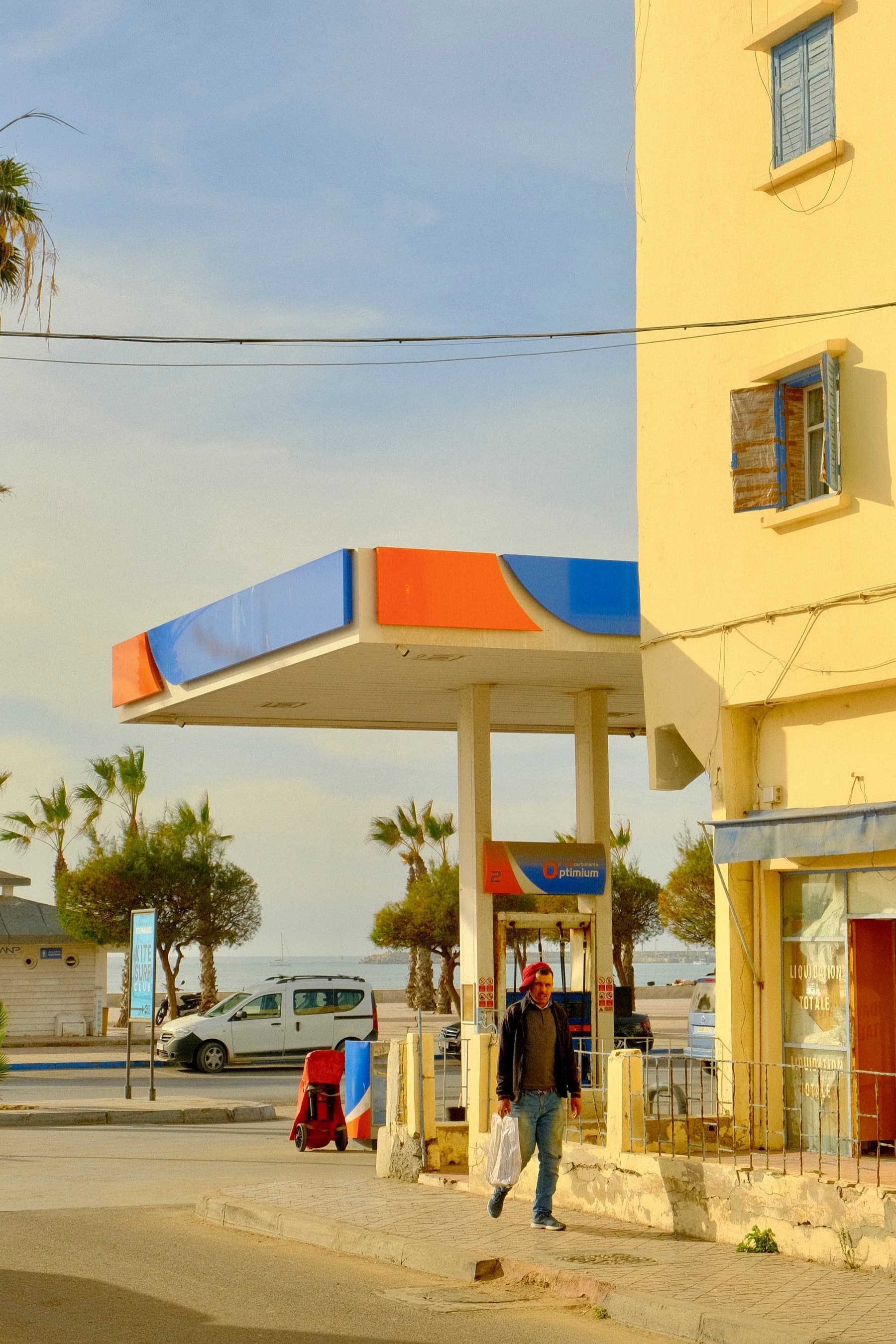
One of the prints from this stretch is not Essaouira at all. It is a filling station on the coast road with the Atlantic behind it — the sort of ordinary place you pass through without stopping. We stopped. Photography is the art of finding beauty in the overlooked, and a petrol station with an ocean behind it is about as overlooked as it gets.
